Yeah, cool that you’re here!
Table of content
Shapes (… soon)
Wheels (… soon)
Expectation Management (… soon)
What is an INCH?
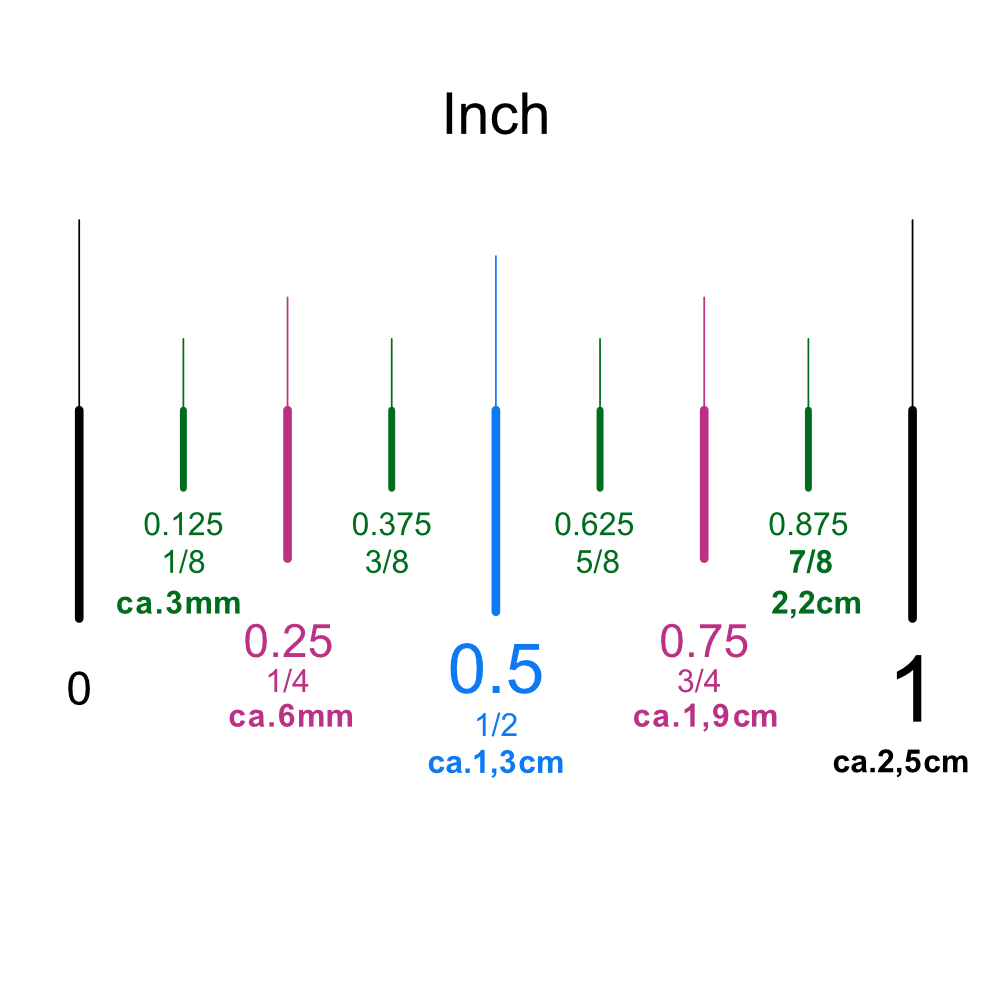
Ok let’s start with the basics. What is an Inch? Skateboard parts are often measured in Inch. This unit is widely used in the US, which is the birthplace of the skateboard. Here are a few examples to get used to it. When you’ve got this down you can make much more sense from all the numbers later on.
1 Inch = 2,54 cm
(1″)
For example deck sizes are defined by the width of the deck. The difference between an 8.0″ and 8.5″ deck is:
0.5″ = ca.1,3cm
(1/2 Inch)
For example deck wheelbases. The difference between a 14″ and a 14.25″ wheelbase is:
0.25″ = ca. 6 mm
(1/4 Inch)
The smallest steps used for skateboard sizes are 1/8 Inches. For example tye difference between an 8.0″ and an 8.125″ deck is:
0.125″ = ca. 3 mm
(1/8 Inch)
7/8 Inch you’ve probably seen on hardware packages.
7/8 Inch = 0.875″
(2,2cm)
Wheelbase
The wheelbase plays an important role in how agile or stable a skateboard behaves. A shorter wheelbase makes the turning radius smaller and the board becomes more agile. A longer wheelbase makes the turning radius bigger and the board becomes more stable.
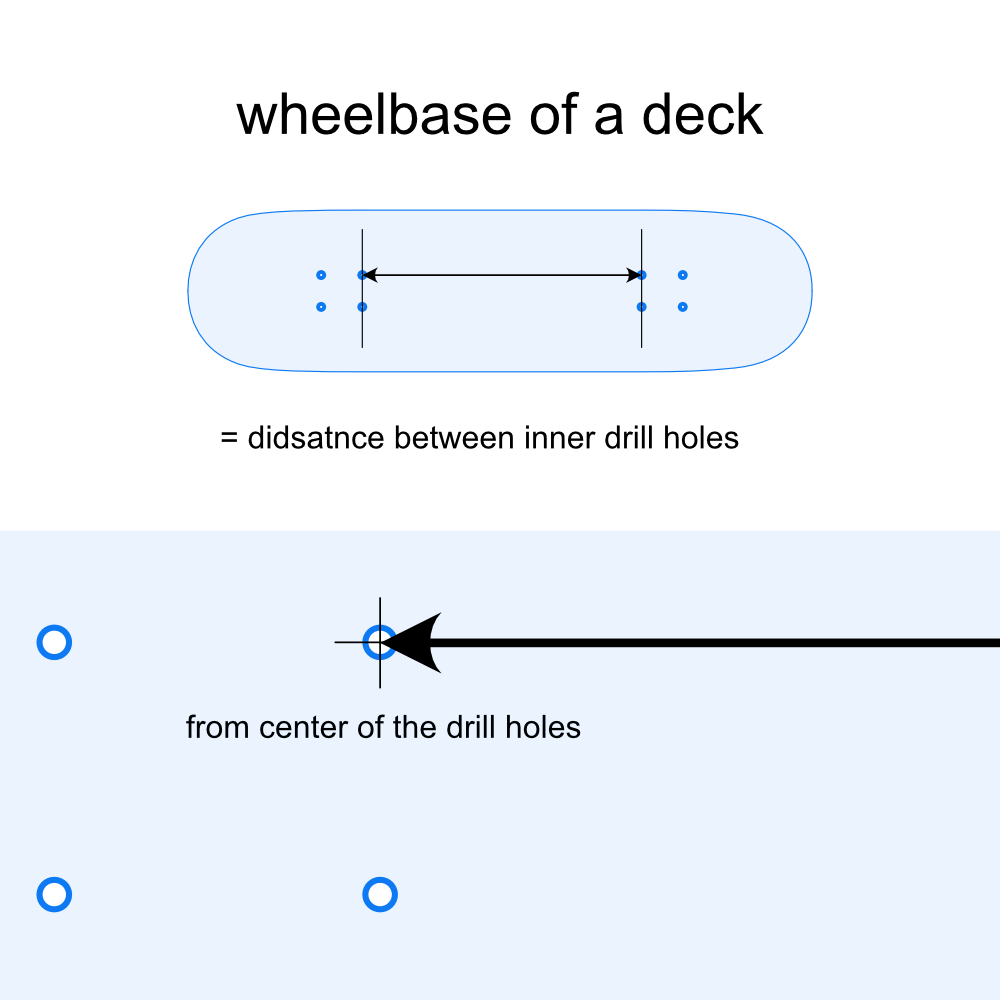
Deck Wheelbase
This is the distance between (the centers) of the inner drill holes. 14″ and below are short. 14.25″ is the standard. 14.5″ and above can be considered as long wheelbases.
Truck offset
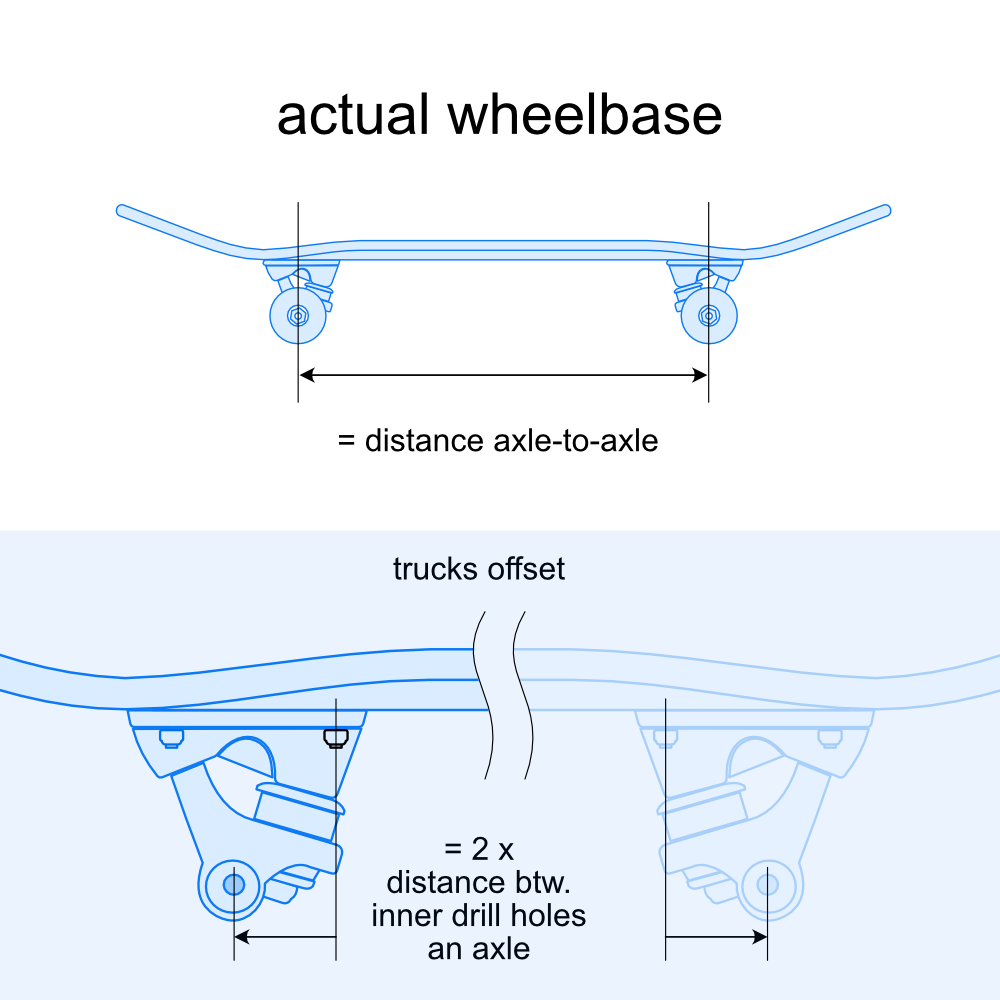
The actual wheelbase of a skateboard is the distance from axle-to-axle. The difference between the deck wheelbase and the actual wheelbase comes from the truck offset. This varies dramatically between the different truck brands (up to 1/2″) .
Truck Offsets change the
1. wheelbase of the board.
2. wheelie compfort. The offset changes the nose / tail length too, which give you more / less leverage for wheelies.
3. Pop Angle. See next topic.
Offset by manufacturer:
(numbers provided by Freedom Skateshop)
ACE
Classic (+2.76″)
AF1 Hollow (+2.76″)
AF1 Low (+2.83″)
AF1 Low Hollow (+2.83″)
AF1 (+2.95″)
Slappy
(measured by Professor Smitt)
ST1 etc. (+3.06″)
Independent
Forged Titanium (+2.91″)
Forged Hollow (+3.07″)
Standard (+3.15″)
Hollow (+3.15″)
Mid (+3.15″)
Tremendous Trucks
(official partner of INPEDDO)
Pro (+3.15″)
Premium (+3.15″)
Standard (+3.15″)
Basic (+3.15″)
Thunder
Titaniums (+3.08″)
Team Hollows (+3.15″)
Lights (+3.15″)
Hollow Lights (+3.23″)
Standard (+3.27″)
Venture
High (+3.23″)
Hi Lights (+3.35″)
Venture Forged (+3.5″)
These figures are additions to the deck wheelbase. For example a deck with 14.25″ wheelbase and trucks listed at (+3.15″) yields 17.4″ axle-to-axle.
POP Angle (PA)
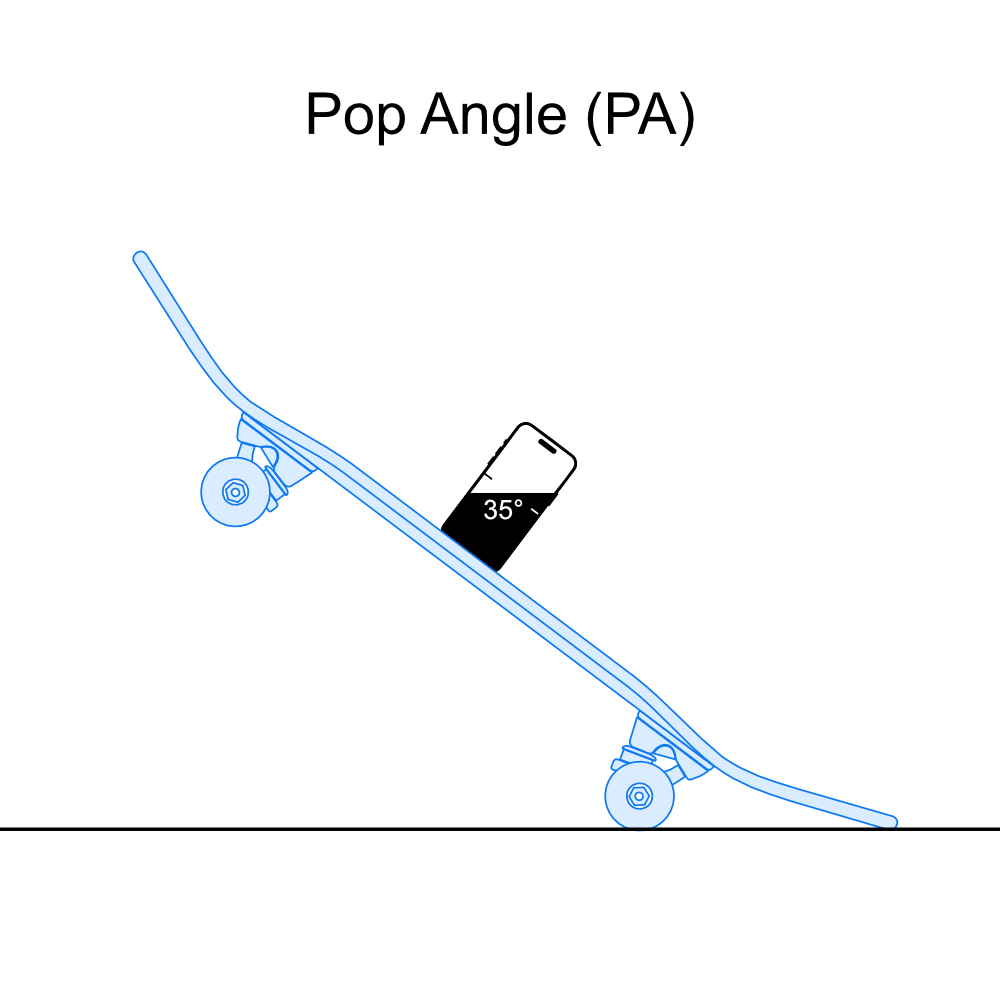
The PA is important for how the Ollie feels. It’s how steep your deck goes up when the tail hits the ground. Mostly you speak about the Tail-PA but there is also a Nose-PA which is important for the Nollie.
A small PA (34° and lower) makes your board easy to pop. This is more compfortable but on the other hand this makes your pop weak. With a relatively big PA (36° and higher) you need more power to hit the tail on the ground. But this makes your pop also stronger.
5 factors influence the PA:
1. kick-angles of the deck. The steeper the kick of nose or tail – the steeper also becomes the PA. Some decks have a steeper nose, but most are symmetrical.
2. nose/tail length: The shorter the nose/tail – the steeper the pop.
3. trucks offset: The larger truck offset (the longer the actual wheelbase) – the steeper the PA.
4. truck height: The higher the trucks – the steeper the PA.
5. wheel size The bigger the wheels – the steeper the PA.
The right truck size
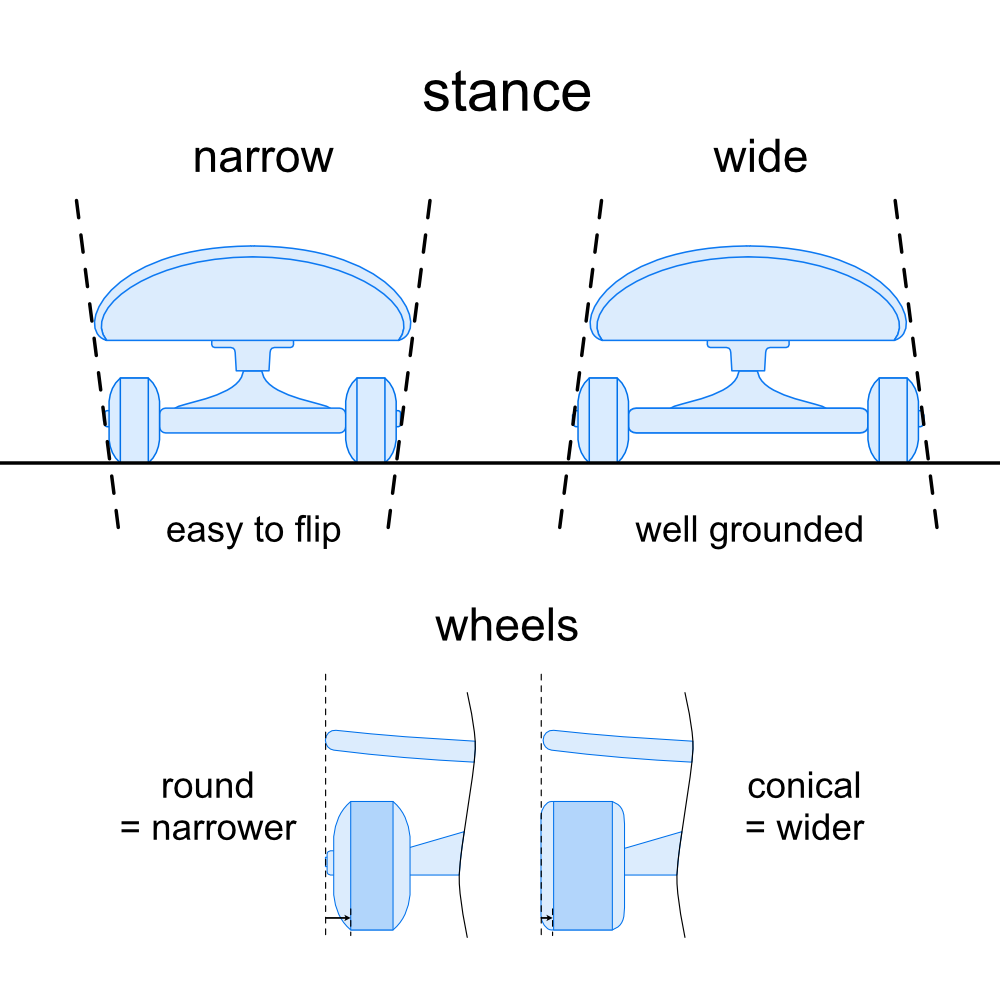
The decks width and trucks axle width should be about the same. Yet better no more than a 1/4″ differnce. Note that for example a skateboard with a 1/4″ narrow stance the axle is just 1/8″ narrower on each side.
Also the wheel shape influences the stance of your board.
Truck Pivot Angle
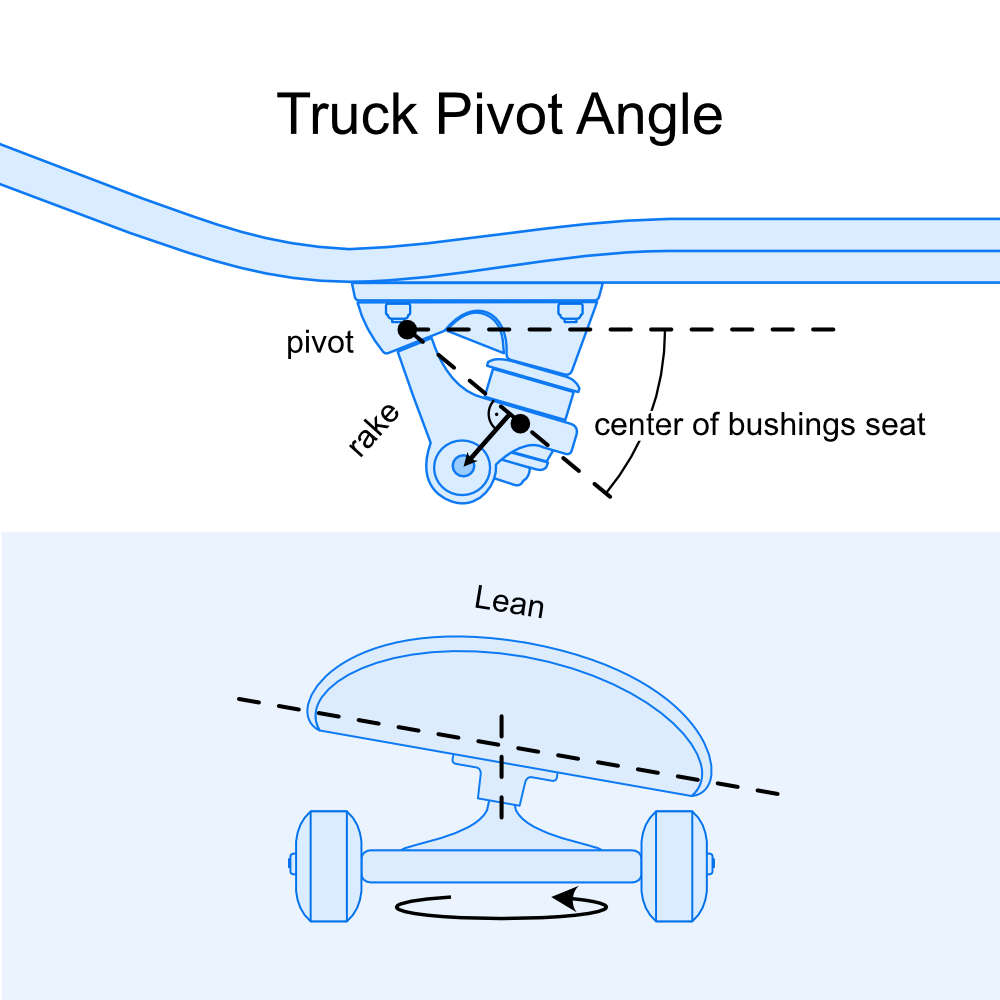
This is deep nerd stuff and it will be discussed here only in short. The Pivot Angle defines the character of the truck. It determines how much the hanger turns (how small the turning radius becomes) when you lean the deck.
For example ACE trucks have a big Pivot Angle. You need to lean the deck only a little bit and the hangers will already turn a lot. This makes the board very agile but it also reacts quite fast on slightest changes of your lean. Venture trucks feel different, cause they have a smaller Pivot Angle. The board is more forgiving and with the lean you can manipulate the board much finer. But you have to pay for it with less agility and faster wheelbites. The differences are very small in reality and is it all a just matter of being used to it. But now that you know about the Pivot Angle you can experiment with trucks characteristics to support your personal riding style.
The Pivot Angle is the ange between the deck and the line between pivot and the center of the bushings seat. The architecture of normal skateboard trucks is called Traditional King Pin. It has a rake so that the bushings sit behind the axle.
Concave
Everybody knows what concave is – the curvature of the deck in the area beween the kicks. In the early days skateboard decks were flat boards. Boards with concave are less likely to break. And it also gives the shoe more area to grip when you pull ollies. Some people prefer deeper concaves. This pronouces the edge which gives the rider a feel like rails that you can “hold on”. It comes on the cost that you board feels less elastic. Deep concaves are als excausting for the feet, cause its unnatural to stand in a concave surface. What fewer people notice is that there are two main types of concaves. The radial and tub concave. The tub concave takes away stress from the feet. Whereas the radial concave structurally allows tight pockets.
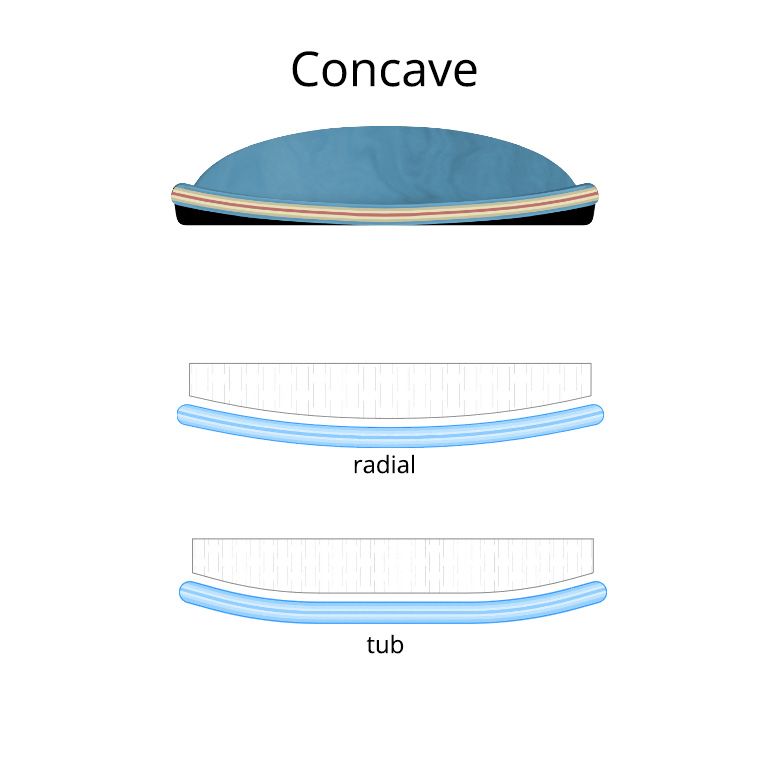
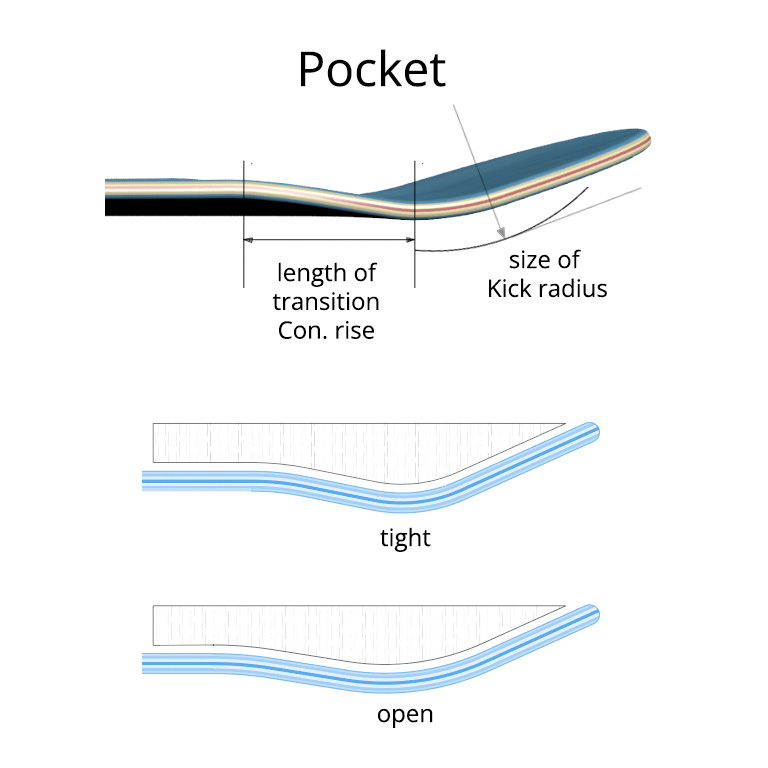
Tight pockets create precise foot placement, locking you into the board for maximum leverage during slappies, powerslides, and Ollie 360s. That tight contour also keeps you firmly anchored in the deck when locked into rail slides.
An open pocket gives your feet room to micro-adjust for finesse maneuvers. The flatter contour creates a longer, smoother drag line before your foot leaves the deck, giving flip tricks and aerial rotations a more fluid pop and drift.
Both pocket designs excel in their own right. It all comes down to your personal skate style. Tight pockets give you locked-in leverage for heavy power moves, while open pockets unlock total foot freedom for effortless technical finesse. Choose the feel that fuels your ride.
A pocket’s geometry is defined by two key transitions: the inner edge is driven by how gradually it sweeps into the side concave (length of transition aka Concave rise), while the outer edge is defined by the tightness (size) of the Kick radius.
Our Medium, Deep and Fullshape decks have tight pockts.
Our Flatbottoms and Mellow decks have open pockets.
Our Squaretails have a medium tight/open pocket.
Kick angle
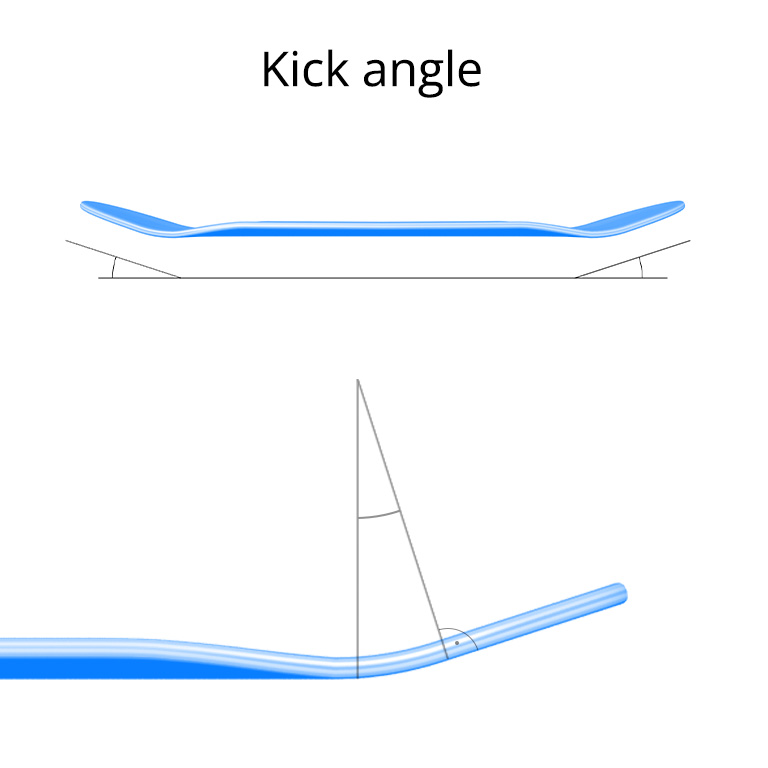
The kick angle determines the nose and tail’s steepness, directly dictating the board’s pop angle. INPEDDO decks feature slightly mellower kick angles—giving you quick, effortless snap with less tail-pushing effort while still packing heavy, crisp pop.
Our Short and Wide decks feature lower kick angles to account for standard adult trucks and wheels on a shorter deck. Without this adjustment, the smaller nose and tail would create an overly steep pop angle, making ollies nearly impossible for young riders. The lowered kick angle counterbalances this geometry, keeping the pop angle at the optimal 35 degrees for effortless pop.
The Mold
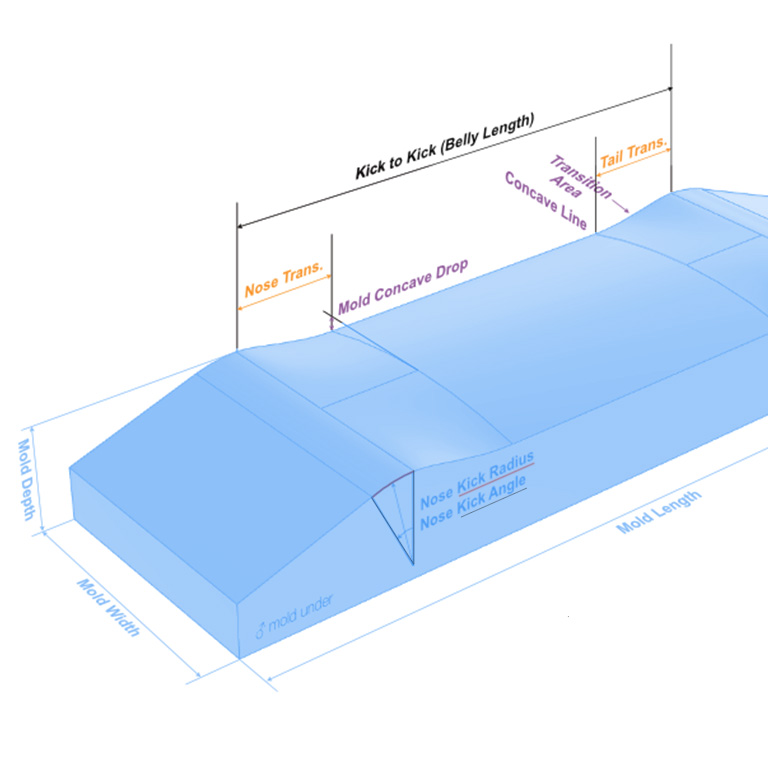
The mold is the 3D form in which the decks are pressed. Here you can see again the Concave, the Pocket and the Kick angle.
Kick to Kick distance: Or the “Belly length” determines the length of the mold. It’s the distance between the kicks. E.g. kids molds are very short. In a given mold its possible to press decks with wheelbases within a certain range. The INPEDDO medium and deep mold works within 14″ to 14.5″ wheelbases. The drill holes of our decks are not shifted forward or backward but are always centered. Shorter decks like the Mid-Sizes use a different mold.